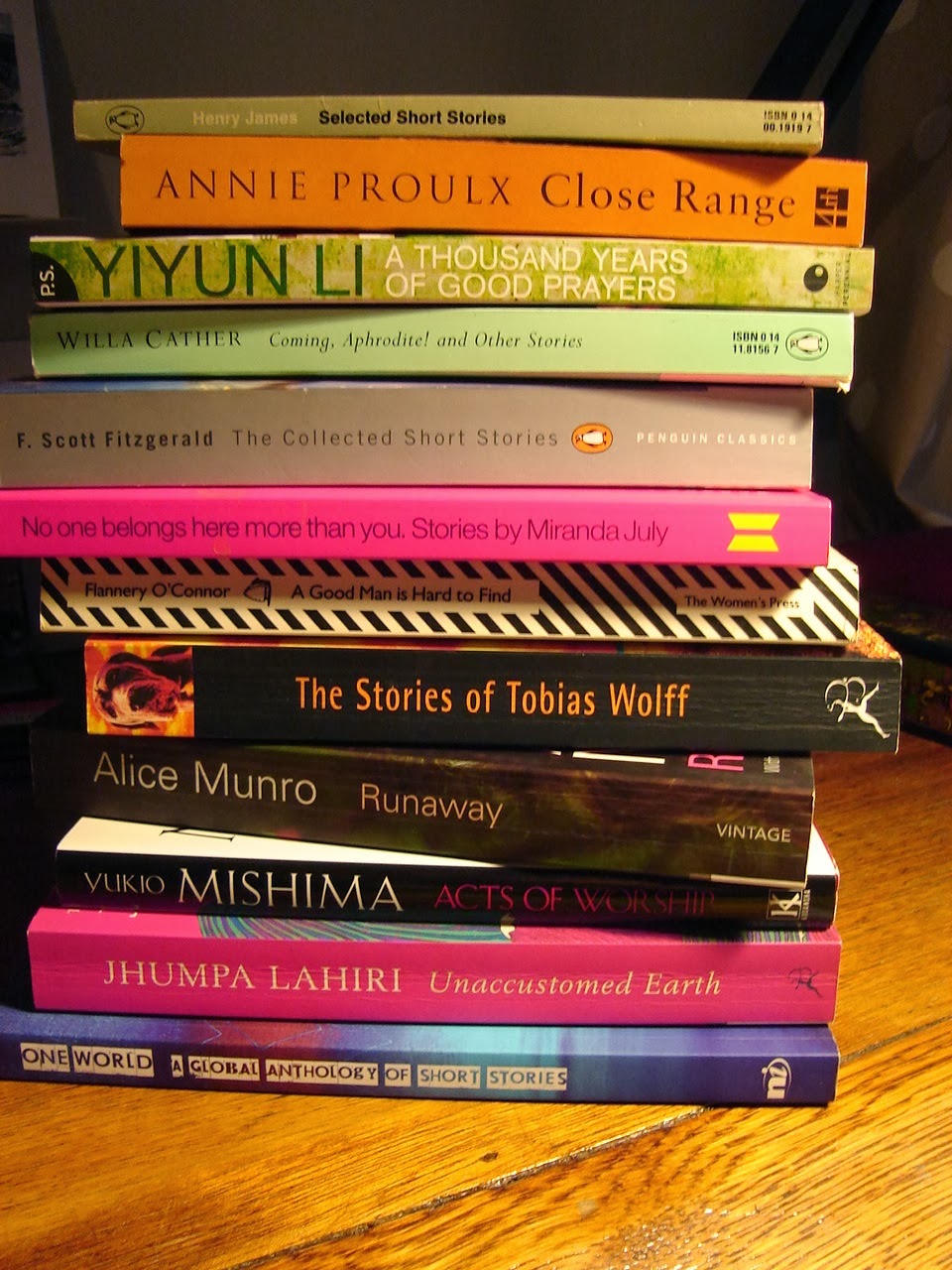
When all is said and done: technical skill noted, originality box ticked, believable characters conveyed etc. etc. ... our choice of favourites comes down to very personal components. Our own selection: what moves, excites, impresses will vary as much as we all do as individuals. It stands to reason that not everyone will enjoy the same stories and this difference enhances the rich diversity of writers and their readers. My own picks have been chosen for a variety of reasons but above all because for me the world shifted a little when I read them. If they were stars I know I would be looking out for them every night.
So every now and then, in between other items on this blog, I will drop in one of my recommendations. I hope you enjoy them as much as I do and that you find something new to delight you...and if you know them already I hope you’ll be drawn to read them again.
DARK HORSES by Claire Keegan
This story is taken from her collection ‘Walk the Blue Fields’ publ. Faber & Faber (2007).
I had not heard of Claire Keegan until I came across this wonderful anthology. It is always such a pleasure to discover a new writer whose work both stimulates and satisfies on so many levels. It is the depth of her humanity, the spareness of her writing that sets her apart for me. Deceptively simple, profoundly eloquent stories that leave you with a lurch in your heart.
In many of them the air between people is thick with the consequence of their histories and often carries the weight of damage they’ve inflicted on each other. There are tensions waiting to snap, passions roused and spent, past events worming their way to the surface, slowly by infinite degree.
In this story Brady, every night, dreams of the woman he has lost:
‘She’s out in the yard with the big hunter, laughing, praising her dark horse.’
This sentence, suffused with sexual meaning, introduces the relationship she and Brady once had. Her horse, this dark creature, represents her own desire, passion and perhaps even Brady himself. So the concept of the dark horse is introduced right at the start and lurking quietly at the back of our minds is its alternative meaning and the prospect of something unexpected looming on the horizon.
A man who has been too fond of the drink is haunted by his own loneliness, the barren nature of his solitary life and how less of a man he feels with the loss of his woman. How this contrasts with his neighbour McQuaid:
‘... a man walking through fields greener than his own.’
Fields that were once Brady’s. But it isn’t only the literal fields that are so verdant for McQuaid, he has a wife, status, a little money all things that Brady lacks, everything he’s lost. And so Brady drinks with the other lost souls in the bar. It is the farrier, Leyden, who has drawn him here, a man who puts small jobs his way when he needs his skill handling difficult horses. He is another man who has a home, rather than just somewhere to live ... and a wife.
For all his passion and empathy, it is Brady’s betrayal of these qualities, his reckless disregard of them when blinded by drink, that ruins his life.
This story, as with others in the collection, reveals more with each reading and rewards. It is subtle, allowing readers space to work things out for themselves – a quality I particularly appreciate – here there is emotional depth. The simple truth is profound, as bare and as rich as the land and this landscape of rural Ireland, from which the characters are drawn, can be unforgiving. Life is harsh, money scarce, rewards few yet there are riches to be found in the telling of its tales.
A must for anyone who loves reading and writing short stories.
Thursday, 20 November 2014
Wednesday, 28 May 2014
A Sense of Place – RED HOUSE ‘Life is short, but art endures.’
When I was a teenager I discovered The Pre-Raphaelites and was smitten. The jewel-like colours in their paintings, the depiction of myths and legends, those never-ending tresses falling down the backs of maiden’s fabulous clothes, all were a feast for a yearning fourteen year old to gobble up. And gobble I did! I had a whale of a time going all medieval within the confines of suburbia and I love the paintings still, though I am not uncritical of the role bestowed upon women in quite a lot of them. Still, I am grateful for what else they led me to and in particular to the genius of William Morris and the glorious Arts and Crafts movement. Imagine then the absolute wonder of wonders to discover that he’d lived literally a fifteen minute walk away from me. I passed his home frequently after that but could only see the boundary wall, all of it too tall for me to peer over for a glimpse of that extraordinary house – Red House. My frustration was palpable. I could run my fingers along those gloriously ruddy red bricks, feel the history but couldn’t see a thing. However, a brief but tantalising view from a coach window gave me one unexpected glimpse over that wall on a school trip and I loved what I saw. But, that was the closest I got. I treasured the memory topping it up over the years by looking at photographs in books I collected. A private house, at that time, there was no way I was going to get any further ... until last summer.
Decades after I had grown and moved away from the area I returned and walked straight through the front gate, up the drive and into the house by a side entrance. It was bliss. Now owned by the National Trust, Red House is open to the public and undergoing conservation work which has already revealed previously unknown paintings. However well you think you know somewhere from pictures, architectural drawings, photographs, nothing prepares you for the real thing. It’s a three-dimensional, sensual experience inhabiting the space, looking out through the windows, just being there. I could feel my fourteen year old self fizzing with excitement as I ran my hand along the bannister rail, no longer the outsider looking in.
The house is fairly sparsely furnished – most of the furnishings long dispersed– but gradually piece by piece, a chair here a table there is being added to the collection and other household objects designed by Philip Webb (the architect), Morris, and their contemporaries, acquired and displayed. But despite its lack of items the house still feels very much a home and one I would be very happy to live in I can tell you! Although Morris and his family only actually lived here themselves for a short time it does, of course, still feel very much their place and much of that is thanks to the wonderful Ted and Doris Hollamby who lived here for over forty years caring for the place as best they could while making it work as a home for themselves and their family. How wonderful that a young architect of the fifties, along with his fellow architect Dick Toms, should see the worth of this place and buy it. Who knows what might have happened if they hadn’t?
There is so much to enjoy here: the bull’s-eye windows, Burne-Jones stained glass, brick arches, lovely garden but above all the atmosphere. It sets off the imagination and you can almost hear Morris busying himself about the place with plans and ideas or playing with ‘the littles’ – his young daughters Jenny and May. It is a place that inspires and creates the necessary physical, mental and emotional space for creative minds to fly. (I have visited one of Philip Webb’s other houses: Standen in East Sussex. It too is a joy.)
Morris has been a hero of mine for many years and the more I’ve learnt about him the more impressed with him I’ve become. If you think all he did was make fabric and wallpaper think again! A writer, conservator (he helped to inspire the birth of the National Trust), social reformer, designer, printer ... it’s an extraordinary list of achievements and yes, there are his exquisite fabric designs seen in a huge variety of guises all over the world still, more than a hundred and twenty years after his death.
Red House is a gem lovingly peopled by The Friends of Red House who act as guides and volunteers safe in the knowledge that their own contribution has helped to secure a safe future for this wonderful place.
If you ever visit South East London I highly recommend a visit, it’s a stone’s throw from Greenwich Park and the Maritime Museum and even nearer to the recently restored Danson House – a whole lot of other gems!
Monday, 10 February 2014
Books to Inspire – No. 2
‘Field Guide to Writing Flash Fiction’ edited by Tara L.Masih (Rose Metal Press) AND ‘Short Circuit : A Guide to the Art of the Short Story’ edited by Vanessa Gebbie (SALT publishing)
Okay, I know there are two books here, but they make such perfect companions it feels unnatural to split them apart. They work so well in tandem and if you haven’t come across them before then you’re not only in for a treat, but also some of the best writing advice you could get.
I shall admit straightaway that I know the editor of ‘Short Circuit’, but that’s not why I’ve chosen it, although I could sing her praises long and loud! I know some people don’t like to review work by colleagues, to avoid accusations of cronyism etc. but this guide is just too good to miss and if you doubt my word just check out how many creative writing courses have it on their reading lists. The endorsements on the cover are pretty impressive too:
On ‘Short Circuit.’: ‘An essential read. A gold mine...’ – The Bridport Prize
‘...wisdom and insight hop off the page like light on water.’ – Clem Cairns, the Fish Prize
And ....
On ‘Field Guide..’: ‘...Each essay is a gem, encrusted with outstanding
prompts and valuable exercises.’ – Dinty Monroe, editor of
The MAMMOTH Book of Miniscule Fiction
Hopefully, that’s whetted your appetite! Both books follow a similar format with chapters created by writers with an impressive track record in the respective mediums; most are multi-award winners, with prizes from some of the most prestigious writing competitions under their belts. Both books also cover a wide range of subjects, within each form, with suggestions for further exploration, plus a variety of exercises.
Field Guide to Writing Flash Fiction edited by Tara L. Masih (The Rose Metal Press)
'A successful flash enchants us, each small story successfully rendered engulfing us for a brief moment .... in its own brand of light, or truth.' So says Tara Masih in her informative and engaging introduction.
A burgeoning form in this twenty first century, Masih informs us that it has actually been around much longer than most people think – in fact since the early part of the nineteenth when Washington Irving and Edgar Allan Poe were amongst its earliest proponents.
Now, in this age of compression, where all aspects of life are crammed ever more cheek by jowl, the flash seems the ideal bite-size fiction to savour in those increasingly brief moments we have to ourselves. So it follows that as the flash itself garners more attention, with a high online profile and a growing number of writers engaging in the form, the inevitable 'How To Do It' books should start pouring from the publishers.
There are many writing guides, brought in on the wave of Creative Writing courses steadily multiplying across the globe. There are good ones and bad ones: the Field Guide to Writing Flash Fiction is definitely a good one; I would even say a very good one. It doesn't promise unparalleled success or anything else it can't deliver, but does provide real insight into how writers work in this medium doing exactly what it says on the cover – providing guidance that gently leads the would-be flash writer along the path to making their own work truly shine.
Collectively, the twenty five essays contained here explore the different facets of writing good flash fiction and such a prismatic approach reveals much of the art to writing the very best of them. The authors, many distinguished and multi-award winners amongst them, are all actively engaged in the form as either writers, teachers or editors – some in all three – and precisely because of this experience, they don't mess around but go straight to the heart of what they want to say. Each focuses on an aspect of either writing, teaching or editing flash fiction and what they convey is frequently eloquent, often illuminating, always passionate as forceful advocates of the form.
The book covers ten main areas ranging from 'In Defense of the Exercise', through others such as 'Beginnings and Endings' and 'Taking Risks' to 'A Call to Action'. Each of these is further defined by the essays themselves with inevitable titles like Expose Yourself to Flash and Flash in the Pan, but don't let that put you off, under the puns you'll find some incisive, educative writing.
Many sections are inspiring and with the added bonus of both top notch examples of the form, and exercises to get the creative juices flowing – at the end of each one – this makes the volume an invaluable addition to any writer's reference collection.
A couple of the contributors do get a little caught up in their own philosophising, but are no less interesting for that and there are some truly inspiring pieces to get fingers flashing across keyboards and pens moving in hot little hands.
It seems churlish to single out specific authors from the pack, when so much of the writing here is good, but both Jennifer Pieroni and Vanessa Gebbie deserve a special mention for getting me to briefly abandon this review, in order to go and write a new flash myself! I really can't think of a better recommendation than that.
(My review for 'Field Guide' first appeared on Jane Smith’s blog. ‘How Publishing Really Works’.)
‘Short Circuit: A Guide to the Art of the Short Story’ edited by Vanessa Gebbie
There are twenty seven sections here covering such areas as ‘Finding Form in Short Fiction’, ‘Writing and Risk Taking’, ‘Setting’, ‘Endings‘ and ‘Short Story Competitions ...’
One of the joys of this book, as with its companion above, is the multitudinal approach to its subject. As well as examining the nuts and bolts of writing, by choosing so many different writers to talk about them a huge variety of perspectives are presented. This shows, with real clarity, just how many different approaches can be taken, how rules can be made, followed and broken. It’s not that any one writer here specifically contradicts another, far from it, but that each offers their own unique approach and encourages the reader to pursue their own too. There are examples of what excites them as readers themselves and what gets their own creative juices flowing:
Adam Marek sums this up brilliantly in the section ‘What my Gland Wants – Originality in the
Short Story’:
‘When I read or write fiction, what I’m really doing is hunting for a very particular sensation. It’s a feeling a bit like delight, a bit like surprise, a bit like weightlessness. It’s the excitement we get when we discover something new, something which in childhood we can’t take a step without tripping over, but which in adulthood is woefully infrequent. ....Originality is the most important thing in fiction for me. My gland needs things it has never experienced before. And when I’m thinking about ideas for a short story, it’s my gland that I’m guided by.’
For each writer there is their own way, their own uniqueness to embody and ‘Short Circuit’ celebrates this, encourages the writer to explore, experiment and dare themselves to push their own boundaries. At the same time it highlights elements that are common to them all and gives invaluable practical advice. There are lists of reference books to consult, anthologies to explore, individual stories to encounter and free pages at the end for notes too. It is thorough, engaging, informative, a delight and one of the best, (if not THE best) books on the short story. In fact, I can only think of one that might just top it, buy a slim margin, and that’s its new edition!
If I am stuck, get swamped by ideas, need to home in on the heart of a piece etc. it is to these two books that I return again and again. They help me cut through the layers and engage with the nucleus of what I am trying to say; they are quite simply brilliant.
Okay, I know there are two books here, but they make such perfect companions it feels unnatural to split them apart. They work so well in tandem and if you haven’t come across them before then you’re not only in for a treat, but also some of the best writing advice you could get.
I shall admit straightaway that I know the editor of ‘Short Circuit’, but that’s not why I’ve chosen it, although I could sing her praises long and loud! I know some people don’t like to review work by colleagues, to avoid accusations of cronyism etc. but this guide is just too good to miss and if you doubt my word just check out how many creative writing courses have it on their reading lists. The endorsements on the cover are pretty impressive too:
On ‘Short Circuit.’: ‘An essential read. A gold mine...’ – The Bridport Prize
‘...wisdom and insight hop off the page like light on water.’ – Clem Cairns, the Fish Prize
And ....
On ‘Field Guide..’: ‘...Each essay is a gem, encrusted with outstanding
prompts and valuable exercises.’ – Dinty Monroe, editor of
The MAMMOTH Book of Miniscule Fiction
Hopefully, that’s whetted your appetite! Both books follow a similar format with chapters created by writers with an impressive track record in the respective mediums; most are multi-award winners, with prizes from some of the most prestigious writing competitions under their belts. Both books also cover a wide range of subjects, within each form, with suggestions for further exploration, plus a variety of exercises.
Field Guide to Writing Flash Fiction edited by Tara L. Masih (The Rose Metal Press)
'A successful flash enchants us, each small story successfully rendered engulfing us for a brief moment .... in its own brand of light, or truth.' So says Tara Masih in her informative and engaging introduction.
A burgeoning form in this twenty first century, Masih informs us that it has actually been around much longer than most people think – in fact since the early part of the nineteenth when Washington Irving and Edgar Allan Poe were amongst its earliest proponents.
Now, in this age of compression, where all aspects of life are crammed ever more cheek by jowl, the flash seems the ideal bite-size fiction to savour in those increasingly brief moments we have to ourselves. So it follows that as the flash itself garners more attention, with a high online profile and a growing number of writers engaging in the form, the inevitable 'How To Do It' books should start pouring from the publishers.
There are many writing guides, brought in on the wave of Creative Writing courses steadily multiplying across the globe. There are good ones and bad ones: the Field Guide to Writing Flash Fiction is definitely a good one; I would even say a very good one. It doesn't promise unparalleled success or anything else it can't deliver, but does provide real insight into how writers work in this medium doing exactly what it says on the cover – providing guidance that gently leads the would-be flash writer along the path to making their own work truly shine.
Collectively, the twenty five essays contained here explore the different facets of writing good flash fiction and such a prismatic approach reveals much of the art to writing the very best of them. The authors, many distinguished and multi-award winners amongst them, are all actively engaged in the form as either writers, teachers or editors – some in all three – and precisely because of this experience, they don't mess around but go straight to the heart of what they want to say. Each focuses on an aspect of either writing, teaching or editing flash fiction and what they convey is frequently eloquent, often illuminating, always passionate as forceful advocates of the form.
The book covers ten main areas ranging from 'In Defense of the Exercise', through others such as 'Beginnings and Endings' and 'Taking Risks' to 'A Call to Action'. Each of these is further defined by the essays themselves with inevitable titles like Expose Yourself to Flash and Flash in the Pan, but don't let that put you off, under the puns you'll find some incisive, educative writing.
Many sections are inspiring and with the added bonus of both top notch examples of the form, and exercises to get the creative juices flowing – at the end of each one – this makes the volume an invaluable addition to any writer's reference collection.
A couple of the contributors do get a little caught up in their own philosophising, but are no less interesting for that and there are some truly inspiring pieces to get fingers flashing across keyboards and pens moving in hot little hands.
It seems churlish to single out specific authors from the pack, when so much of the writing here is good, but both Jennifer Pieroni and Vanessa Gebbie deserve a special mention for getting me to briefly abandon this review, in order to go and write a new flash myself! I really can't think of a better recommendation than that.
(My review for 'Field Guide' first appeared on Jane Smith’s blog. ‘How Publishing Really Works’.)
‘Short Circuit: A Guide to the Art of the Short Story’ edited by Vanessa Gebbie
There are twenty seven sections here covering such areas as ‘Finding Form in Short Fiction’, ‘Writing and Risk Taking’, ‘Setting’, ‘Endings‘ and ‘Short Story Competitions ...’
One of the joys of this book, as with its companion above, is the multitudinal approach to its subject. As well as examining the nuts and bolts of writing, by choosing so many different writers to talk about them a huge variety of perspectives are presented. This shows, with real clarity, just how many different approaches can be taken, how rules can be made, followed and broken. It’s not that any one writer here specifically contradicts another, far from it, but that each offers their own unique approach and encourages the reader to pursue their own too. There are examples of what excites them as readers themselves and what gets their own creative juices flowing:
Adam Marek sums this up brilliantly in the section ‘What my Gland Wants – Originality in the
Short Story’:
‘When I read or write fiction, what I’m really doing is hunting for a very particular sensation. It’s a feeling a bit like delight, a bit like surprise, a bit like weightlessness. It’s the excitement we get when we discover something new, something which in childhood we can’t take a step without tripping over, but which in adulthood is woefully infrequent. ....Originality is the most important thing in fiction for me. My gland needs things it has never experienced before. And when I’m thinking about ideas for a short story, it’s my gland that I’m guided by.’
For each writer there is their own way, their own uniqueness to embody and ‘Short Circuit’ celebrates this, encourages the writer to explore, experiment and dare themselves to push their own boundaries. At the same time it highlights elements that are common to them all and gives invaluable practical advice. There are lists of reference books to consult, anthologies to explore, individual stories to encounter and free pages at the end for notes too. It is thorough, engaging, informative, a delight and one of the best, (if not THE best) books on the short story. In fact, I can only think of one that might just top it, buy a slim margin, and that’s its new edition!
If I am stuck, get swamped by ideas, need to home in on the heart of a piece etc. it is to these two books that I return again and again. They help me cut through the layers and engage with the nucleus of what I am trying to say; they are quite simply brilliant.
Thursday, 2 January 2014
2014 : New beginnings
They say ‘start as you mean to go on’ – whoever the great ‘they’ are! As one of those glib homilies it’s actually not bad when you think about it. Preparation is often the key to success in so many things, so building a secure foundation to support yourself is a pretty fundamental requirement for achievement – however small or immense.
The New Year is a good time to take stock, reflect, digest, learn and shift up a gear. There are all sorts of reasons why time and space get swallowed up in our lives and it can sometimes be genuinely tough to re-claim what we need but staking that claim is vital. January is a good time for this with the added bonus of knowing there are thousands of people out there in the ether trying to do the same thing. You can feel it in the air and if you’re a tweeter, or facebook devotee, you’ll see it for yourselves: loads of people like you, trying to make a difference in their lives. The writers amongst us are a part of this, a whole worldwide community often so generous in their mutual support. The ‘good luck’s’, ‘well done’s’ and commiserations are so heartfelt, the ‘go for it’s’ so encouraging and coming from people who really understand because they’re doing it too. And there are many sites painstakingly set up to provide masses of information on every aspect of ‘getting there’ you can think of. It’s all out there, you just have to seek it out or ask someone how to!
Here are a few places you can start:
https://www.writersandartists.co.uk/
http://paulmcveigh.blogspot.co.uk/
http://shortstops.info/
http://isabelcostelloliterarysofa.com/2013/11/20/6%E2%85%94-things-i-learnt-from-rewriting-my-book/
http://www.matthaig.com/snobs-kill-books/
So where does this take you? To the land of no excuses? Perhaps, but I
prefer to think of it as the route to opportunity, to new beginnings and
that feeling of positive anticipation when you don’t know just where
something may lead. The year to come is unwritten, a vastness full of
possibilities. Who says you have to do everything the way you always
have? Some things maybe, but move your axis a little to the left or
right and a whole new vista could open up before you, one which provides
that little bit of time and space.
So, if you didn’t manage to start, or finish, that novel make this the year that you do. If you didn’t enter any, or many, competitions go for them now. If you weren’t able to read the books that you wanted to, choose one and buy/borrow/download it today. Set yourself some goals: realistic ones that you feel are achievable and one or two that are right out of the ballpark – who knows what might happen. Don’t let that critic in your head tell you there’s no point, you’re not good enough, there are loads of other great writers out there. Somebody’s got to win those comps., get published, achieve great things, why shouldn’t it be you? Just make sure you get involved, look and see what you can do to move things along for yourself ... and remember ... you’re not alone ... I’ll be doing it too!!
Tuesday, 8 October 2013
A Gem of Small Wonders
![]() |
| The downs above Charleston |
It is a testament to the rich diversity of its programming, the top quality of its speakers and the gloriously inspirational location that the Small Wonder Festival at Charleston has grown into such a success. For the organisers, ten years must have flown by and it must be heartening to see such a throng of people eagerly swimming their way round the site every Autumn. I have only been once before, when I was lucky enough to win an Asham Award, and I had such a wonderful time I was eager to come back. I managed to cram three events in one day this time and found them all stimulating, inspirational and thought-provoking.
A short story festival is indeed a wonder and attracts readers and writers alike – very often they are also one and the same. Short stories constantly receive such a mixed press. We are told there's no market for them by publishers and booksellers, that nobody reads them, or that they are now enjoying a resurgence! It's sometimes difficult to pick your way towards the truth here, though I suspect that a bit of everything is probably the most accurate reflection. Surely a medium perfect for bite-sized podcasts is ideal for our technological age and those journeys to work? There's such a range of material too covering everything you can think of … and more … from all over the globe. Try a classic Chekhov, Woolf or Dickens. How about something by Flannery O'Connor, Alice Munro or Raymond Carver. There's Helen Simpson, Chimamanda Ngozi Adichie,Vanessa Gebbie, Yiyun Li, Adam Marek, Haruki Murakami …. Some you will know, some not but look them up and you're in for a treat … anything from separations, reunions, unrequited love, lost children … zombie restaurants. Zombie restaurants? Oh yes!
The Man Booker longlistee Alison MacLeod gave a wonderfully vibrant talk about her and eloquently echoed so many of the things I have always felt about her work. It is always heartening to find people who feel the same way as yourself about certain things, even more so when they are people you admire. There was also a lovely reading of 'The Garden Party' – one of her most well known stories – by a young actress, which really set the mood for the evening and placed the audience right at the heart of her writing. A perfect way to end my visit to this year's Small Wonder.
![]() |
| My treasured old school copy |
Charleston is such a unique place, with the slant of the downs curving round its perimeter and, of course, the wonderful farmhouse with its glorious interior imbued with the work and lives of the Bloomsbury Group. I have visited the house a few times before, marveling at the unique exuberance of the decoration on walls, tables, fireplaces, doors, and the other art works by Vanessa Bell, Duncan Grant, Picasso, Renoir, Sickert, Derain … it is an emotive place and the studio, the last room you pass through before leaving, has a charge all of its own – extraordinary.
If you fancy a visit check it out here: http://www.charleston.org.uk/
| The garden at Charleston |
Thursday, 29 August 2013
Notebooks, screens and random scribblings
It’s a curious thing, when someone told me that they only ever write straight onto their computer I couldn’t imagine myself doing the same thing. For a long time I was a longhand girl and had to get a story down on paper, A4 lined and margined, scribbling away with a gel pen. Then I decided to ring the changes just a wee bit by using a cartridge pen, oh fun to be had there by choosing different coloured ink: green, turquoise ... but purple became my ‘stylo du jour’. Great! I loved the way the nib glided over the surface of the paper and the ink flowed – there was something about the physicality of it all, the immediacy that I really enjoyed. When the first draft was done, I’d go back and alter bits, but after several interventions all those lines through the text made a right mess and it wasn’t always easy to see what I was on about! So after a few pages of the next attempt I would type up what I had handwritten, just those first pages and carry on from there, repeating the process every few pages. Then I got a laptop and everything changed. There was no seminal moment, no Damascene conversion I just started to type straight onto it.
It’s a strange process, this mind to fingers routine that taps out the paths of our imagination, but it works for me. Somehow the world I immerse myself in when I’m creating something, wherever it is set, comes fresh onto the screen. I re-draft some bits as I go along too, always looking for the rhythm in the piece, the sea that will carry the raft of characters and their stories. As I come back to something, when I’ve had to leave it for a day or two, seeking out that rhythm helps me re-connect, get the flow coursing again and seeing the words up on the screen in front of me spurs me on. I do print everything out and re-draft, in pencil, usually somewhere comfy with a hot cuppa, (absolutely mandatory), but somehow there’s a crispness to the screen, probably because it doesn’t have my pencil scribblings all over it! It sort of entices you to carry on, to fill that space below the last paragraph.
![]() |
| A fancy schmancy one! |
![]() |
| My favourite – a trusty Moleskine. |
Sunday, 21 July 2013
Books to Inspire – No. 1
There will be a whole variety of these, as my blogs progress, but I want to kick everything off here with one of my favourite 'dipping into' tomes. If my creative juices get dammed up or my brain just needs some time out, I love picking a page at random in here:
'How I Write: The Secret Lives of Authors' edited by Dan Crowe with Philip Oltermann publ. Rizzoli (New York)
This book is filled with all sorts of fabulous stuff that works, as it says itself: '…. like an old curiosity shop, full of letters, photographs, drawings, illustrations, and other scattered mementoes.' With over sixty essays, of varying lengths, from some of the worlds' most established authors we find out how A.L. Kennedy's only writing prop is her notebook, (one for each book), why Ian Rankin treasures a photograph of Edinburgh's Oxford Bar in his office, what Lionel Shriver's antidote to character names is and see Will Self's wall of post-it notes (it's huge!). There are a whole variety of props and talismans that writers find useful to aid the process: Siri Hustvedt keeps her late father's collection of 'unknown keys' by her when she writes, they help her to unlock rooms to unfamiliar spaces that lead to new stories.
As writers are we not fascinated by human nature, by what people do? That delving into the psyche is part and parcel of creating characters, themes, narrative … the whole shebang. In their introduction Dan Crowe and Philip Oltermann cite how they wanted to '..tear down the invisible wall between us readers and them writers and see what's really going on behind the page. What keeps writers gong? If not money, what is their fix? What gets them high? What gets them low?…' This fascinates me as a reader, it's interesting I want to know more, but as a writer it connects on a whole other level. It's the human story that grabs me. Yes it's appealing to discover what well known writers use to break through blocks, or energise a flagging mind etc. and sometimes helpful, but that germ of intrigue is like finding a sherbet lemon in a bag of toffees, it's the human story that grabs me and fires up my imagination. It's like Siri Hustvedt's keys.
Every time I go to this book I discover something new which delights and intrigues me, as well as coming across favourite entries that chime with my mood at the time. Like Siri Hustvedt I might get ideas for a story, discover a new character or just put isolation to one side as I realise someone I admire goes about things the same way I do – that's a comfort and an inspiration. Breaking out of solitary to share for a moment or two is heartening, a gift and it reminds me that I'm not alone, that there's a whole nation of writers /artists out there. It reminds me of writing friends, colleagues and all those amazing people I meet on the net.
The entries are so diverse, so rich, it's a wonderful collection of writerly lucky dips and beautifully presented to boot. Just flicking through its pages is as much a visual feast as anything else and there really is so much pleasure in a visit. Lovers of Letterpress will swoon. But the very best thing about it for me is that it was a gift, my first Christmas present from my lovely son-in-law, he searched it out – oh how well he knows me! Thank you Martin!!
I will leave you with just one entry, from Melissa Bank who says of her talisman – a photo from The New York Times:
'It captures the emotion for me – the ungainly struggle, the possibility of rescue, the blind faith writing requires. It also reminds me that the alternative is drowning in a flooded cage in the zoo.'
'How I Write: The Secret Lives of Authors' edited by Dan Crowe with Philip Oltermann publ. Rizzoli (New York)
This book is filled with all sorts of fabulous stuff that works, as it says itself: '…. like an old curiosity shop, full of letters, photographs, drawings, illustrations, and other scattered mementoes.' With over sixty essays, of varying lengths, from some of the worlds' most established authors we find out how A.L. Kennedy's only writing prop is her notebook, (one for each book), why Ian Rankin treasures a photograph of Edinburgh's Oxford Bar in his office, what Lionel Shriver's antidote to character names is and see Will Self's wall of post-it notes (it's huge!). There are a whole variety of props and talismans that writers find useful to aid the process: Siri Hustvedt keeps her late father's collection of 'unknown keys' by her when she writes, they help her to unlock rooms to unfamiliar spaces that lead to new stories.
As writers are we not fascinated by human nature, by what people do? That delving into the psyche is part and parcel of creating characters, themes, narrative … the whole shebang. In their introduction Dan Crowe and Philip Oltermann cite how they wanted to '..tear down the invisible wall between us readers and them writers and see what's really going on behind the page. What keeps writers gong? If not money, what is their fix? What gets them high? What gets them low?…' This fascinates me as a reader, it's interesting I want to know more, but as a writer it connects on a whole other level. It's the human story that grabs me. Yes it's appealing to discover what well known writers use to break through blocks, or energise a flagging mind etc. and sometimes helpful, but that germ of intrigue is like finding a sherbet lemon in a bag of toffees, it's the human story that grabs me and fires up my imagination. It's like Siri Hustvedt's keys.
Every time I go to this book I discover something new which delights and intrigues me, as well as coming across favourite entries that chime with my mood at the time. Like Siri Hustvedt I might get ideas for a story, discover a new character or just put isolation to one side as I realise someone I admire goes about things the same way I do – that's a comfort and an inspiration. Breaking out of solitary to share for a moment or two is heartening, a gift and it reminds me that I'm not alone, that there's a whole nation of writers /artists out there. It reminds me of writing friends, colleagues and all those amazing people I meet on the net.
The entries are so diverse, so rich, it's a wonderful collection of writerly lucky dips and beautifully presented to boot. Just flicking through its pages is as much a visual feast as anything else and there really is so much pleasure in a visit. Lovers of Letterpress will swoon. But the very best thing about it for me is that it was a gift, my first Christmas present from my lovely son-in-law, he searched it out – oh how well he knows me! Thank you Martin!!
I will leave you with just one entry, from Melissa Bank who says of her talisman – a photo from The New York Times:
'It captures the emotion for me – the ungainly struggle, the possibility of rescue, the blind faith writing requires. It also reminds me that the alternative is drowning in a flooded cage in the zoo.'
Subscribe to:
Posts (Atom)